 By Mei Takahashi
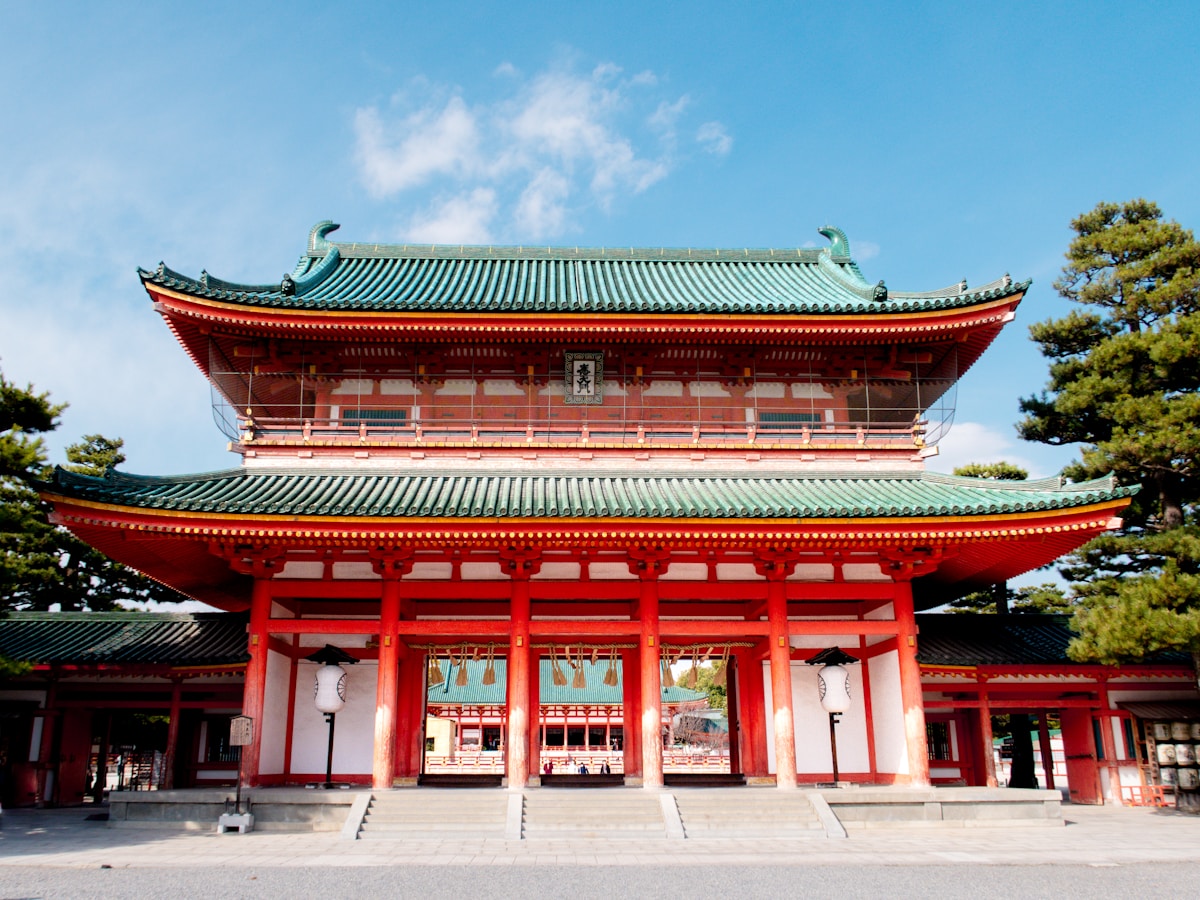
A Shrine Born from Nostalgia
Heian Shrine (Heian Jingu) was built in 1895 to commemorate the 1,100th anniversary of Kyoto becoming the capital. After the imperial court moved to Tokyo in 1868, Kyoto fell into decline. The shrine was part of a movement to revive the city's spirit — and it was deliberately designed to be bold, bright, and unmistakably Kyoto.
The shrine is dedicated to Emperor Kanmu (who founded Kyoto in 794) and Emperor Komei (the last emperor to rule from Kyoto). Its architecture is a 5/8ths scale replica of the Heian-era Imperial Palace's main hall (Chodo-in) — the same bright vermilion and green-roofed style that defined the original palace a thousand years ago.
The Giant Torii
Standing 24.2 meters tall on the main approach (Oten-mon Dori), the great torii gate of Heian Shrine is one of the largest in Japan. It is made of reinforced concrete (a modern material chosen for durability), painted the same vermilion as the shrine. The gate serves as both a landmark visible from the nearby streets and a dramatic frame for photos — especially when framed with cherry blossoms in spring or ginkgo leaves in autumn.
The Garden: Shinen
Behind the main hall lies the Shinen — a stroll garden spanning roughly 30,000 square meters. This is where Heian Shrine truly shines. Designed by Ogawa Jihei (Ueji VII), one of Japan's greatest garden architects, the garden is divided into four sections built around a central pond:
- Higashi Shin-en (East Garden): A pond shaped like the Chinese character for "heart," bordered by weeping cherry trees that are spectacular in mid-April — later than most Kyoto cherries.
- Nishi Shin-en (West Garden): A quieter garden with a crescent-shaped pond and Ryubidan stepping stones arranged in the form of a dragon.
- Naka Shin-en (Middle Garden): Features the famous Garyukyo bridge — stepping stones repurposed from pillars of the original Heian-era Imperial Palace. In June, irises bloom along the water's edge in one of Kyoto's most underrated flower displays.
- Minami Shin-en (South Garden): The most recently designed section, with a tea house and a tranquil pond.
The garden is enclosed by walls that block out the surrounding city completely. Step through the gate and you enter another world — a world of water, stone, and carefully framed views that change with every few steps.
Jidai Matsuri: The Festival of Ages
Every October 22nd, Heian Shrine hosts the Jidai Matsuri (Festival of Ages) — one of Kyoto's three great festivals. A procession of 2,000 people in historically accurate costumes walks from the Imperial Palace to Heian Shrine, representing every era of Kyoto's 1,100-year history as capital. The costumes range from Meiji-era dignitaries to Heian-era court nobles in junihitoe (twelve-layered robes). It is a living museum parade.
Taiko Bridge
Inside the East Garden, the Taihei-kaku bridge spans the pond in a gentle arch. It is one of the most photogenic spots in Kyoto — a red wooden bridge reflected in still water, framed by maples or cherries depending on the season.
Practical Information
| Detail | Info |
|---|---|
| Hours | 6:00 AM - 6:00 PM (5:30 PM in winter) |
| Entry fee | Shrine grounds: Free. Shinen garden: 600 yen |
| Getting there | 5-minute walk from Higashiyama Station (Subway Tozai Line); 10 min from Gion |
| Time needed | 1-2 hours (garden is the highlight) |
| Combine with | Nanzen-ji (10-min walk), Ginkaku-ji/Philosopher's Path (30-min walk north) |
| Best season | Mid-April (weeping cherries), June (irises), November (autumn foliage) |
⛩️ Heian Shrine's garden is 10 minutes from Gion. Pair a shrine visit with a kimono stroll through Kyoto's eastern temples.